


Page 14 - Vermilion Lake Association Spring 2021 Newsletter
P. 14
It’s the Law: Dispose of Unwanted Bait in the Trash not the Lake
All of us want to be good stewards of the lake, and part of that involves not inadvertently introducing aquatic invasive species (AIS)
or pathogens such as bacteria, viruses and parasites into the ecosystem. Releasing unwanted bait such as minnows, crawlers and leeches into the lake has the potential to introduce these contaminants.
Many people who dump bait into the lake have the misconception that they are doing some good by feeding hungry fish or that it’s cruel to put bait in the trash. Those compassionate feelings are entirely understandable; however, the potential for spread- ing diseases to other baitfish or gamefish and AIS is simply too great of a risk. Fish diseases such as viral hemorrhagic septicemia can be spread in this man- ner, as well as AIS such as zebra mussel larvae.
Let’s take viral hemorrhagic septicemia as an exam- ple of how the introduction of a pathogen can wreak havoc on the ecosystem. First discovered in Europe- an fish stocks in the 1930s, viral hemorrhagic septi- cemia was found for the first time in the Great Lakes in 2005, and in Wisconsin’s Lake Winnebago in 2006. It is a threat to more than 25 fish species including muskies and walleye. Fish can be infected by eating infected fish or coming into contact with the virus by water passing through their gills. For more detailed information, both the Minnesota and Wisconsin DNR’s have a webpage dedicated to this topic.
Another example of how invasive species can have detrimental effects on NE Minnesota’s boreal forest ecosystem has to do with earthworms. Earthworms
are not native
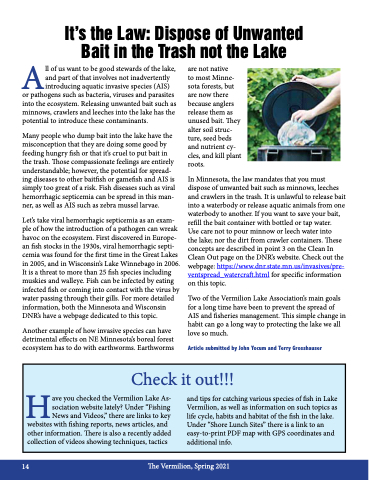
to most Minne- sota forests, but are now there because anglers release them as unused bait. They alter soil struc- ture, seed beds and nutrient cy- cles, and kill plant roots.
In Minnesota, the law mandates that you must dispose of unwanted bait such as minnows, leeches and crawlers in the trash. It is unlawful to release bait into a waterbody or release aquatic animals from one waterbody to another. If you want to save your bait, refill the bait container with bottled or tap water.
Use care not to pour minnow or leech water into
the lake; nor the dirt from crawler containers. These concepts are described in point 3 on the Clean In Clean Out page on the DNR’s website. Check out the webpage: https://www.dnr.state.mn.us/invasives/pre- ventspread_watercraft.html for specific information on this topic.
Two of the Vermilion Lake Association’s main goals for a long time have been to prevent the spread of AIS and fisheries management. This simple change in habit can go a long way to protecting the lake we all love so much.
Article submitted by John Yocum and Terry Grosshauser
    Have you checked the Vermilion Lake As- sociation website lately? Under “Fishing News and Videos,” there are links to key
websites with fishing reports, news articles, and other information. There is also a recently added collection of videos showing techniques, tactics
and tips for catching various species of fish in Lake Vermilion, as well as information on such topics as life cycle, habits and habitat of the fish in the lake. Under “Shore Lunch Sites” there is a link to an easy-to-print PDF map with GPS coordinates and additional info.
Check it out!!!
 14 The Vermilion, Spring 2021


