


Page 6 - Vermilion Lake Association Spring 2021 Newsletter
P. 6
Featuring Lake Vermilion’s “Most Unwanted” Species...the fourth in a series.
 What are they?
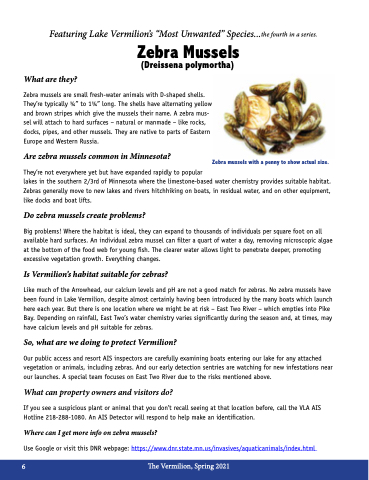
Zebra mussels are small fresh-water animals with D-shaped shells. They’re typically 1⁄4” to 11⁄4” long. The shells have alternating yellow and brown stripes which give the mussels their name. A zebra mus- sel will attach to hard surfaces – natural or manmade – like rocks, docks, pipes, and other mussels. They are native to parts of Eastern Europe and Western Russia.
Are zebra mussels common in Minnesota?
Zebra mussels with a penny to show actual size.
Zebra Mussels (Dreissena polymortha)
  They’re not everywhere yet but have expanded rapidly to popular
lakes in the southern 2/3rd of Minnesota where the limestone-based water chemistry provides suitable habitat. Zebras generally move to new lakes and rivers hitchhiking on boats, in residual water, and on other equipment, like docks and boat lifts.
Do zebra mussels create problems?
Big problems! Where the habitat is ideal, they can expand to thousands of individuals per square foot on all available hard surfaces. An individual zebra mussel can filter a quart of water a day, removing microscopic algae at the bottom of the food web for young fish. The clearer water allows light to penetrate deeper, promoting excessive vegetation growth. Everything changes.
Is Vermilion’s habitat suitable for zebras?
Like much of the Arrowhead, our calcium levels and pH are not a good match for zebras. No zebra mussels have been found in Lake Vermilion, despite almost certainly having been introduced by the many boats which launch here each year. But there is one location where we might be at risk – East Two River – which empties into Pike Bay. Depending on rainfall, East Two’s water chemistry varies significantly during the season and, at times, may have calcium levels and pH suitable for zebras.
So, what are we doing to protect Vermilion?
Our public access and resort AIS inspectors are carefully examining boats entering our lake for any attached vegetation or animals, including zebras. And our early detection sentries are watching for new infestations near our launches. A special team focuses on East Two River due to the risks mentioned above.
What can property owners and visitors do?
If you see a suspicious plant or animal that you don’t recall seeing at that location before, call the VLA AIS Hotline 218-288-1080. An AIS Detector will respond to help make an identification.
Where can I get more info on zebra mussels?
Use Google or visit this DNR webpage: https://www.dnr.state.mn.us/invasives/aquaticanimals/index.html
  6 The Vermilion, Spring 2021


