


Page 9 - Vermilion Lake Association Spring 2021 Newsletter
P. 9
  for walleyes where all fish from 20 to 26 inches must be immediately released. There is a four walleye possession limit with only one fish over 26 inches allowed. Anglers are also reminded that since 2019, northern pike are managed under the northeast zone regulation requiring re- lease of all fish between 30 and 40 inches, only one allowed over 40 inches, and a two fish possession limit. For darkhouse spearing, you are allowed two pike but only one may be over 26 inches. All other fish species are managed under current statewide fishing regulations.
Fishery Management
Lake Vermilion is comprised of two major basins, East Vermilion (east of Oak Narrows) and West Ver- milion (west of Oak Narrows), that are significantly different in terms of habitat and fish communities. The lake is part of the Minnesota Department of Natural Resources (DNR) Large Lake Monitoring Program which includes annual fisheries population assessments, water quality monitoring, zooplankton monitoring, aquatic invasive species surveillance, and regularly scheduled creel surveys on the 10 largest lakes in Minnesota. Since 1984, standardized fish population assessments have included a variety of sampling gears to collect various fish species at different life stages. The gears include gill nets, trap nets, shoreline seines, and electrofishing boats. Fish- eries assessments are standardized so that the same sampling gear is used at the same locations during the same time of year to best track population trends over time. Length, weight, age, and other data are collected for fish of management concern.
The current management plan for Lake Vermilion was designed to guide fisheries management for a six-year period from 2017 to 2022. Since 1971, DNR has annually operated the walleye spawn take and hatchery at the Pike River, a major tributary to Lake Vermilion. A small portion of the walleye fry pro- duced annually at the Pike River Hatchery are put back into Lake Vermilion. In the previous 10 years, between 5 and 15 million fry have been stocked annually. DNR’s walleye spawn take operations
were suspended in 2020 due to COVID-19 safety
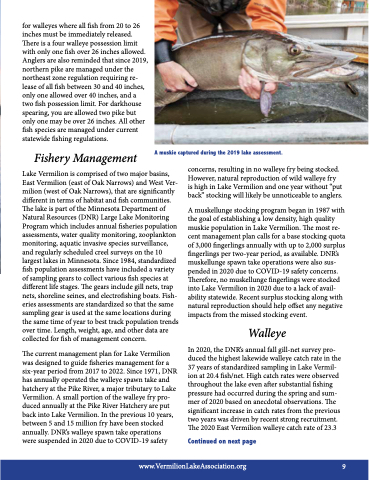
A muskie captured during the 2019 lake assessment.
concerns, resulting in no walleye fry being stocked. However, natural reproduction of wild walleye fry is high in Lake Vermilion and one year without “put back” stocking will likely be unnoticeable to anglers.
A muskellunge stocking program began in 1987 with the goal of establishing a low density, high quality muskie population in Lake Vermilion. The most re- cent management plan calls for a base stocking quota of 3,000 fingerlings annually with up to 2,000 surplus fingerlings per two-year period, as available. DNR’s muskellunge spawn take operations were also sus- pended in 2020 due to COVID-19 safety concerns. Therefore, no muskellunge fingerlings were stocked into Lake Vermilion in 2020 due to a lack of avail- ability statewide. Recent surplus stocking along with natural reproduction should help offset any negative impacts from the missed stocking event.
Walleye
In 2020, the DNR’s annual fall gill-net survey pro- duced the highest lakewide walleye catch rate in the 37 years of standardized sampling in Lake Vermil- ion at 20.4 fish/net. High catch rates were observed throughout the lake even after substantial fishing pressure had occurred during the spring and sum- mer of 2020 based on anecdotal observations. The significant increase in catch rates from the previous two years was driven by recent strong recruitment. The 2020 East Vermilion walleye catch rate of 23.3
Continued on next page
  www.VermilionLakeAssociation.org 9


